Time to draw a line…

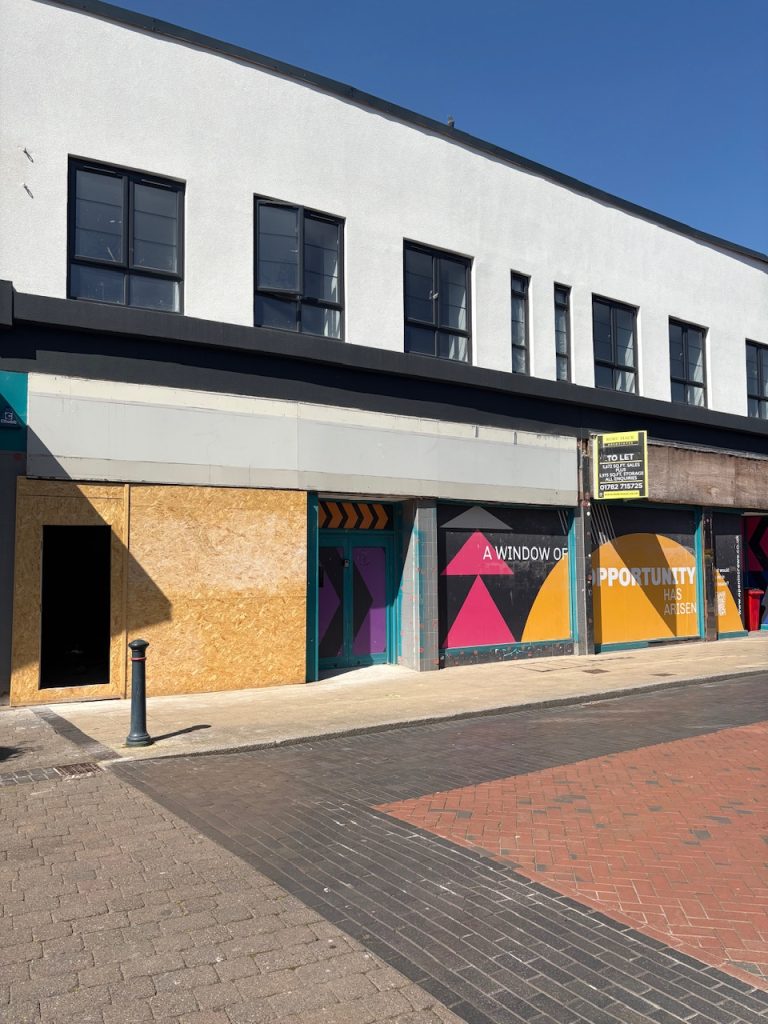
Broken windows, graffiti, old signage, patchy hoardings, peeling paint, crumbling roof, bushes growing out of gutters and so on.

What do the empty units in your town or city centre look like…?

Do they look a state…?

Or…

Has the landlord or agent made them look the best they can be while work continues to get them let.

Has the place – the council or BID maybe – taken the initiative and sorted some vinyls or other options to improve things.
Screenshot

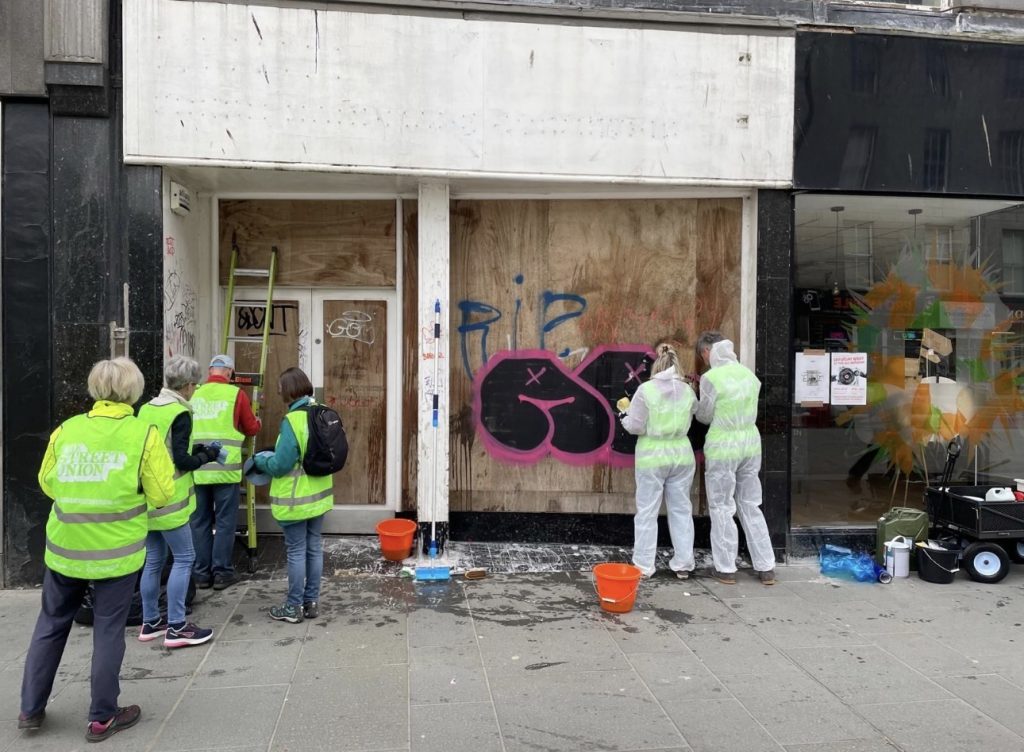
Perhaps, as our friends in Aberdeen are doing (and we feature in the image above), a community volunteers group led by Our Union Street is out regularly with brushes and paint and cleaning to spruce them up.

It maybe seems a minor part of the tackling highstreet vacancy process but it’s important and makes a difference.

There are enough downsides to empty units for the place. If they’re in a poor way it’s worse…

  • They add to a negative perception among residents;
  • Dismay visitors;
  • Attract ASB;
  • Provoke negative media stories;
  • Increase the risk of your place featuring in a national ‘worst for empty shops’ list;
  • Make things harder for existing businesses, increasing the chance that
    they’ll leave also;
  • Discourage inward investment by would-be new occupiers.

So let’s draw a line. Commit as places to doing what we can to make empty units looking bad a thing of the past.

Yes there’s a cost. It’s also true that we say to local teams we’re working with on tackling vacancy that getting the empty units back in play is a priority, but as colleagues who’ve done it will tell you, this helps.

It’d be great to hear what your town or city centre is doing on this…
Posted in News Centre | Comments Off on Time to draw a line…

In a word…

If you were allowed just one word to describe your town or city centre, what would it be…?

Do please let me know yours.

It’s not easy, huh…?

The challenge wasn’t my idea and it’s not one I’d come across before until what was an insightful, enjoyable, encouraging meeting in Cinderford to share thoughts about the town as it is and priorities moving forward.

The question set me thinking about some of the other locations we’re working with local teams on tackling highstreet vacancy, what word we’d get to for them and more importantly the words ‘place partnership’ members there would list.

A really interesting extra talking point to emerge from the meeting was what suggestions might you get if the question was asked of residents and business owners on local social media platforms.

Similarly if you did a visitor survey of people in your town or city centre for the day or overnight, what single word would they use to describe it.

Now you might think that placemaking is far too complex a subject for these answers to be much, if any, use but having experienced it here and reflecting on the 20+ one words that emerged, I do think it’s interesting.

Over to you…

Posted in News Centre | Comments Off on In a word…

If a place had its own empty units agent…?

“It’s a good idea. Seems obvious. So how come we hardly if ever hear any examples.”

It is the option for a place – a town or city centre – to commission its own commercial property agent to work on reducing the number of empty units it has and improving the mix of uses.

To be fair, when we’ve aired this with agents before we’ve not been met with too much enthusiasm, rather the response has been a list of reasons why it wouldn’t work.

It’d be great to hear what property and place leaders or managers think.

Here’s the rationale…

  • On average (based on The Vacant Shops Academy data from locations we’re working with on tackling highstreet vacancy), more than 50 per cent of visibly vacant units don’t have an agent instructed to work on getting them let. Lots of places have a higher figure;
  • There’s a lengthy list of reasons – all seemingly commercially sensible from their perspective – why a landlord might not be proactive about getting empty units a new occupier;
  • If a potential tenant gets in touch with one agent they’ll typically showcase those in their portfolio but not likely many if any others, so if they’ve nothing suitable the search has to start again rather than cover all the potential options a place has;
  • The fee an agent secures for a successful letting might be around 10% of the first year’s rent – for small units in some places that’s not a huge amount and so might limit the affordable effort…

…it also explains why potential pop-up occupiers say they often find little interest from landlords and agents for the idea;

  • On the type of uses, the focus may be on securing a rent-paying (or business rates-covering) tenant rather than one that adds to the mix the place already has. This can mean the number of empties drops by one but residents and existing businesses might not think it’s done much to boost the place.

There’s more, but I think just these help make the case for the ‘place’ to try commissioning its own agent.

So go on. Tell me why not…?

Posted in News Centre | Comments Off on If a place had its own empty units agent…?

Brands new stores for your place…

Which brands do you most want to see taking up empty units in your town or city centre…

…and importantly, are you working, as a team, to try recruit them…?

Screenshot

Typically there are a number of ways places develop their list:

  • checking what they have currently and what’s missing;
  • consulting residents and existing business owners on what they’d like to see;
  • comparing with neighbouring and similar places to see what they have that you could;
  • looking out for agent and property director requirements lists where they set out target locations for new openings.

There’s also a fifth – so far less well-used route – a location planning, data-based one – which we definitely think more could adopt.

Identifying your targets and then working together to recruit them is one of the key tasks we set for ‘place partnership’ teams in locations we’re supporting on tackling highstreet vacancy…

…on the basis that it’s more likely to deliver lettings that add to the mix and are welcomed than if you think of this as “just an agent-landlord thing”.

It’s also worth emphasising that brands are only one of three potential go-to options, the others being independents and uses off our ‘alternative’ / additional list. But the approach is the same.

It’d be really interesting to hear what the targets are for your place and the steps you’re taking to try attract them…!

Posted in News Centre | Comments Off on Brands new stores for your place…

Ready for requirements…?

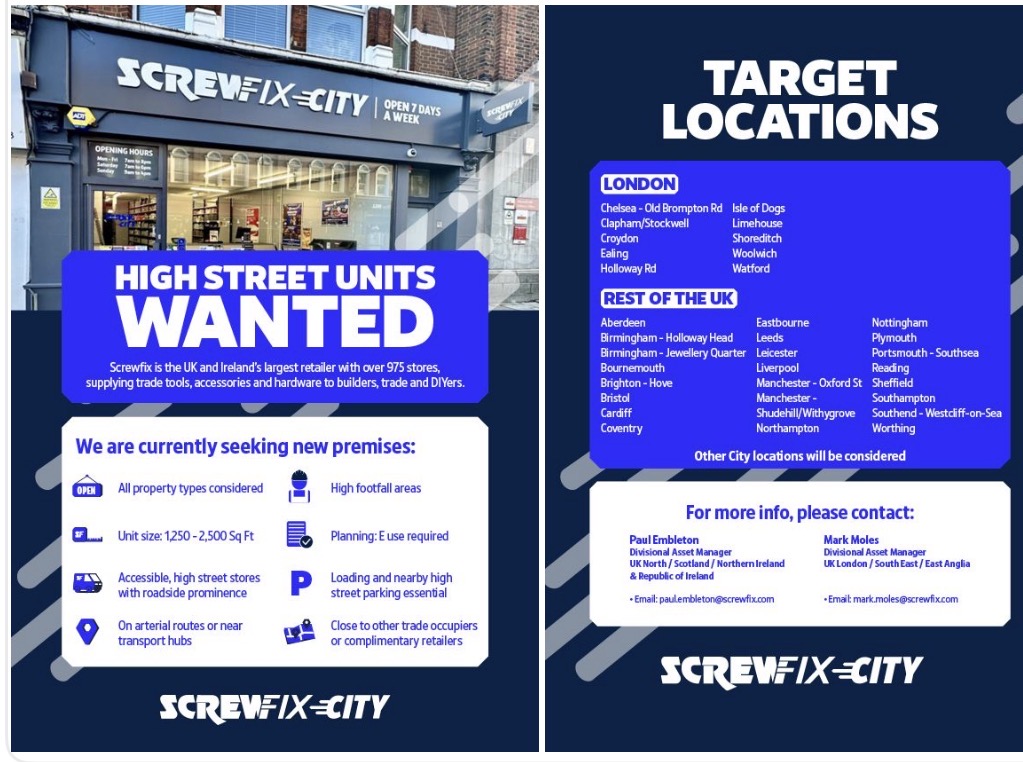
Two more brands published on Friday a list of locations they’d like to open up in.

One listed 19 locations plus another 20 inside the M25. The other featured 22 UK possibles plus 17 more in Central or Greater London.

Is your town or city centre on either list…?

Are you looking out for these ‘requirements’…

…and, importantly, are you geared up as a ‘place partnership’ to connect with agents and property directors when they share these, and do you have details of all empty and available units in your location so you can quickly send them suitable options.

As it’s often the case that the ‘target locations’ list is longer than the number they’ll actually open, this can be a competitive thing, rewarding places that are quick off the mark, most proactive and supportive.

It’s one of the roles we identify for local ‘place partnership’ teams we’re supporting on tackling highstreet vacancy, alongside the work they’re doing to identify vacant units, understand why they’re like that, how the barriers to let can be overcome and which partner needs step up to make that happen.

We’re really interested to see some of the different ways they’re going about that too.

It’d be great to hear from other council and BID teams who are on the case…

Posted in News Centre | Comments Off on Ready for requirements…?

“It’s not like a committee…”

“It just feels like a really important time to be having these positive but also very practical conversations about our high streets.”

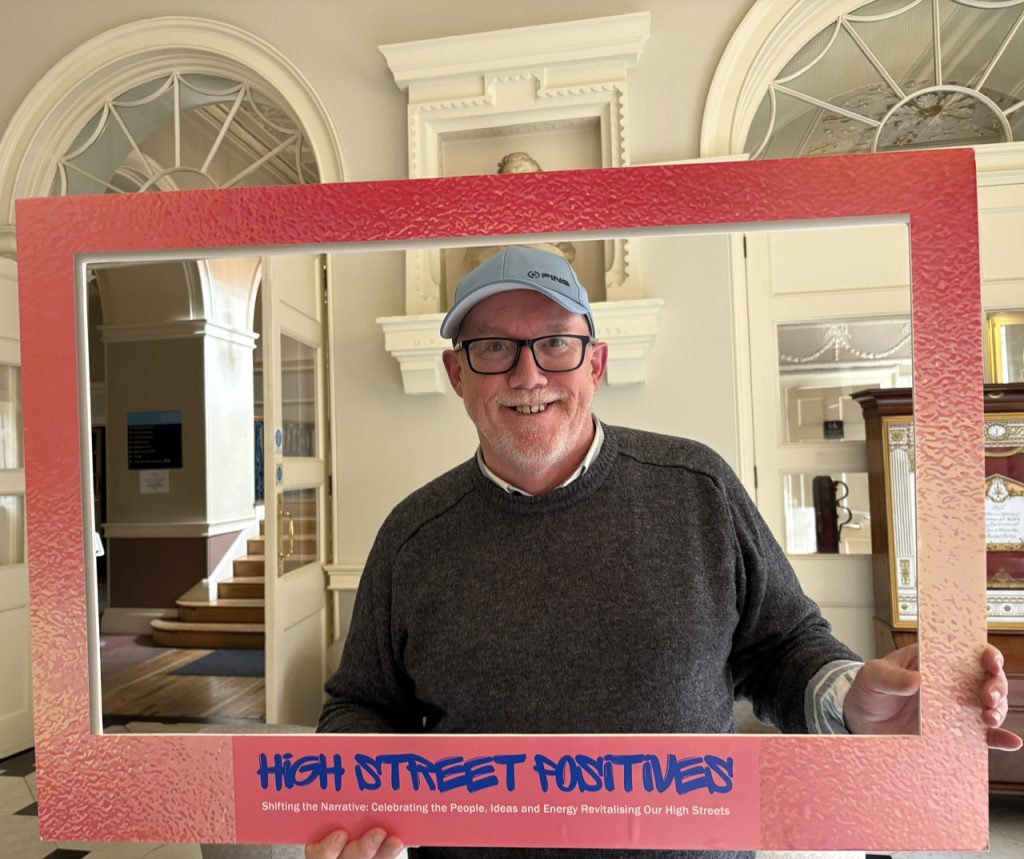
So, reflecting on another insightful, inspiring, heartening day with HighStreetPositives LIVE.

Hosting a three-hour event with 8 panellists, 3 speakers, a ‘fireside chat’, intro and reflections sections, and a head full of questions, timings etc, means it’s taken a little longer to draw out takeaways than the many shared here already over the last 24 hours or so.

Lots of great stuff happening in Bath and neighbour towns but also in a number of other places that contributors spoke about, projects and initiatives to learn from and tailor or adjust so they work in your town or city centre.

For me – along with a number of individual ideas to pick up with colleagues in the days ahead – two things stood out.

First a sense that in the conversations before, on the walking tours, at the break, after we’d closed and in messages since, there’ll be a huge amount built on this in a way it’s harder to do via the online version. So I’m glad that for all the plusses of Teams calls and the like, we still make time to meet IRL.

Second – and this was especially encouraging thinking about our tackling #highstreet vacancy work and the emphasis we put on having a ‘place partnership’ on the case. How much better, stronger, quicker and more sustainably we make progress working together.

In that room – and clearly very much part of the Bath story – we had attendees from business and community, council colleagues, the BID, creative, cultural & heritage organisations and importantly (as they’re often missed out of ‘town board’ type conversations) agents and landlords, as well as a range of specialists who bring particular skill sets to the table.

Not everywhere has this kind of positive, proactive ‘place partnership’ (yet…!) and it’s something we’d love to see become the norm.

It’d be great to hear positive working together examples from your places…

Thanks Laura Harris, thanks to everyone who played a part in a(nother) memorable day…!

Posted in News Centre | Comments Off on “It’s not like a committee…”

Crewe’s journey learning…

“There’s a really interesting tackling town centre vacancy story emerging here.”

When we ran our ‘audit’ in August 2024, Crewe town centre had 24 vacant units out of 141 so a headline vacancy rate of 17% and above the national average which is reported as being around 13.5%.

Today – tho there’ve been some more units become empty and available – a number of lettings mean Crewe’s total looks to be lower.

Everyone involved will emphasise that they’re on a journey and there’s more to do yet but still it feels like there are learnings other places starting their own tackling ‘high street’ vacancy work could draw on.

First is that central to our approach is for local teams to set up a ‘place partnership’ and focus on this issue, while emphasising that’s not the same as a committee so doesn’t need meet regularly, if at all, as long as there are good connectors keeping all the partners up to speed. Crewe’s approach looks more like that model.

Another fundamental element is that places look beyond retail, hospitality and services to what we call an ‘alternative’ / additional list of potential occupier types. That includes arts & crafts, creative, culture, community. For some places – and Crewe is one of those – these looked to be more promising go-to options, at least to start with. And so it’s proved with 3 or 4 of the newer lettings being in that category, with another just announced this week. 

Third has been a number of new developments and infrastructure projects – so not relying on just one to make the difference. Among its additions Crewe has or will soon: a new Youth Zone, an archives centre, a community-led art gallery (called Platform), a co-working space (by TownSq), improved connectivity for cycling & walking to and from the rail station (Southern Gateway Link) and, underway, a new temporary town centre park to boost dwell-time.

Lastly, the town centre had five large empty units left behind by departing retail brands. One is now home to Platform, two others have upper floor residential conversion underway, and the last two are in planning for the same.

As I say, much still to do, but it’s encouraging so far. It’d be great to hear from placemaking colleagues in town or city centres on a similar journey…

Posted in Case Studies, Crewe, News Centre | Comments Off on Crewe’s journey learning…

“Pop-ups: a places perspective”

“Pop-up shops could play a bigger part in our evolving highstreet…”

Every town centre tackling vacancy project I worked on before setting up The Vacant Shops Academy featured a pop-up shop, at least one.

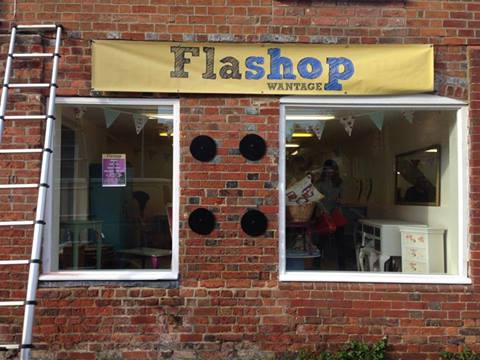
Wantage, our first project, where the number of empty units reduced from 23 to 3 in 18 months, had 3 pop-up units in different parts of the town centre.

Unless they have one in play already, considering starting a pop-up project is among the ‘next steps’ we share with all the locations we’re commissioned on tackling highstreet vacancy. That gives a sense of how valuable we believe they can be.

So, to try encourage greater take-up, we’ve written a new addition to our Academy guides and briefing notes series which explains the ‘why’ and ‘how’ but, importantly, does that from a place rather than pop-up occupier perspective.

Getting empty units back in play on a short-term, temporary basis (hence pop-up or ‘meanwhile… use’) is a well-established and proven option which can have multiple benefits for the place as a whole…

  • It can help kick-start a town or city centre-wide empty shops project
  • brings vacant units back into play
  • improves their look to the benefit of the place and neighbouring businesses
  • adds to the current offer with the potential that has to support existing businesses on footfall and dwell-time
  • allows the place to prioritise uses that add to its current mix and so helps attract additional customers / visitors
  • delivers on the resident / business wish list of ideal new occupier types you’ll draw up at the start of your tackling vacancy project
  • gives you a source of positive media stories at a time when your place might have negative perceptions because of the vacancy issue.

But there are also, importantly, benefits to the businesses and organisations that pop-up there, and these in turn count as positive spin offs for the town or city centre as a whole.

If you are running a pop-up shop project in your place it’d be great to hear how it’s going…

Posted in News Centre | Comments Off on “Pop-ups: a places perspective”

Empty unit, no agent instructed…

We need to fix this issue…

On average more than half of visibly vacant highstreet units don’t have an agent involved in try to get them let.

Do you know what the figure is in your town or city centre…?

Are you working to try put it right…?

We’re keeping a tally of the ‘agent versus no agent’ numbers across the 45 locations The Vacant Shops Academy has tackling vacancy commissions.

The survey covers more than 1,000 units now so that 50+ per cent is a lot of properties maybe getting back into use more slowly than they could be.

And remember it’s an average so because places like Cheltenham or Reading had lower ‘no agent’ percentages (tho in the 20 per cents, still higher than ideal)…others have higher rates, some into the 70s and 80s.

If we can agree that not having an agent proactively working on a letting and as a result no easily accessible information for would-be occupiers to find is a problem, then hopefully you can see why it’s something we ask tackling vacancy-focused ‘place partnership’ teams we’re supporting to try address.

It’d be really interesting to get a sense of the issue as you see it in your place…?

Posted in News Centre | Comments Off on Empty unit, no agent instructed…

Tackling vacancy meets policy objectives…

Getting empty shops back in use can boost ‘Pride in Place’ AND drive economic growth.

As tackling highstreet vacancy is the focus of our work with 45 UK locations now, we’re used to thinking that having too many empty units is just an obvious negative to be put right.

What’s maybe less well explained is how doing that contributes significantly to achieving those two high profile government policy objectives.

Here’s how…

On ‘Pride in Place’, empty units…

  • often look bad so create a negative perception among residents;
  • can attract ASB;
  • provoke negative media stories;
  • increase the risk your place will feature in a national ‘worst for empty shops’ list.

On economy…

  • They’re literally a waste of space that could instead be a growth-building opportunity for local businesses, arts & crafts, creative, culture, community, education, health & wellbeing, especially in places with an ‘inclusive economy’ objective;
  • They make things harder for existing businesses, increasing the chance that they’ll leave also;
  • Discourage inward investment by would-be new occupiers.

Get them back into play, especially when you do that as a ‘place’ so that the lettings are to use types residents and existing businesses have asked for, and…

  • The units look better;
  • There are new occupiers to attract customers who maybe also support existing businesses;
  • Jobs are created;
  • Revenues boosted;
  • Inward investment becomes a better option…
  • …and you have upbeat stories to tell.

Boosting ‘Pride in Place’, driving economic growth.

And all this builds momentum in an upward steps effect, rather than the worsening downward spiral you get with increasing or even stable vacancy.

The real positive here tho is that we know how to reduce empty shop numbers and improve the mix of uses. You can see local town and city centre teams doing it.

Do let us know if your place is up for joining them…

Posted in News Centre | Comments Off on Tackling vacancy meets policy objectives…